An honest comparison starts with the job to be done
Global platforms such as Autodesk Forma, formerly Autodesk Construction Cloud, and Oracle Aconex both provide document management, model coordination, and project workflows at significant scale. In Vietnam, vCDE and VinaCDE also position themselves around ISO 19650, BIM, and approval processes. A checklist asking whether each product has version control, a file repository, or a model viewer therefore tells you very little.
The more useful questions are whether the platform joins the design office, BIM team, construction site, and leadership on one data thread; where that data can be hosted; and who will configure the process, train users, and maintain operating discipline after the accounts are handed over.
Advantage one: four layers of work on one data spine
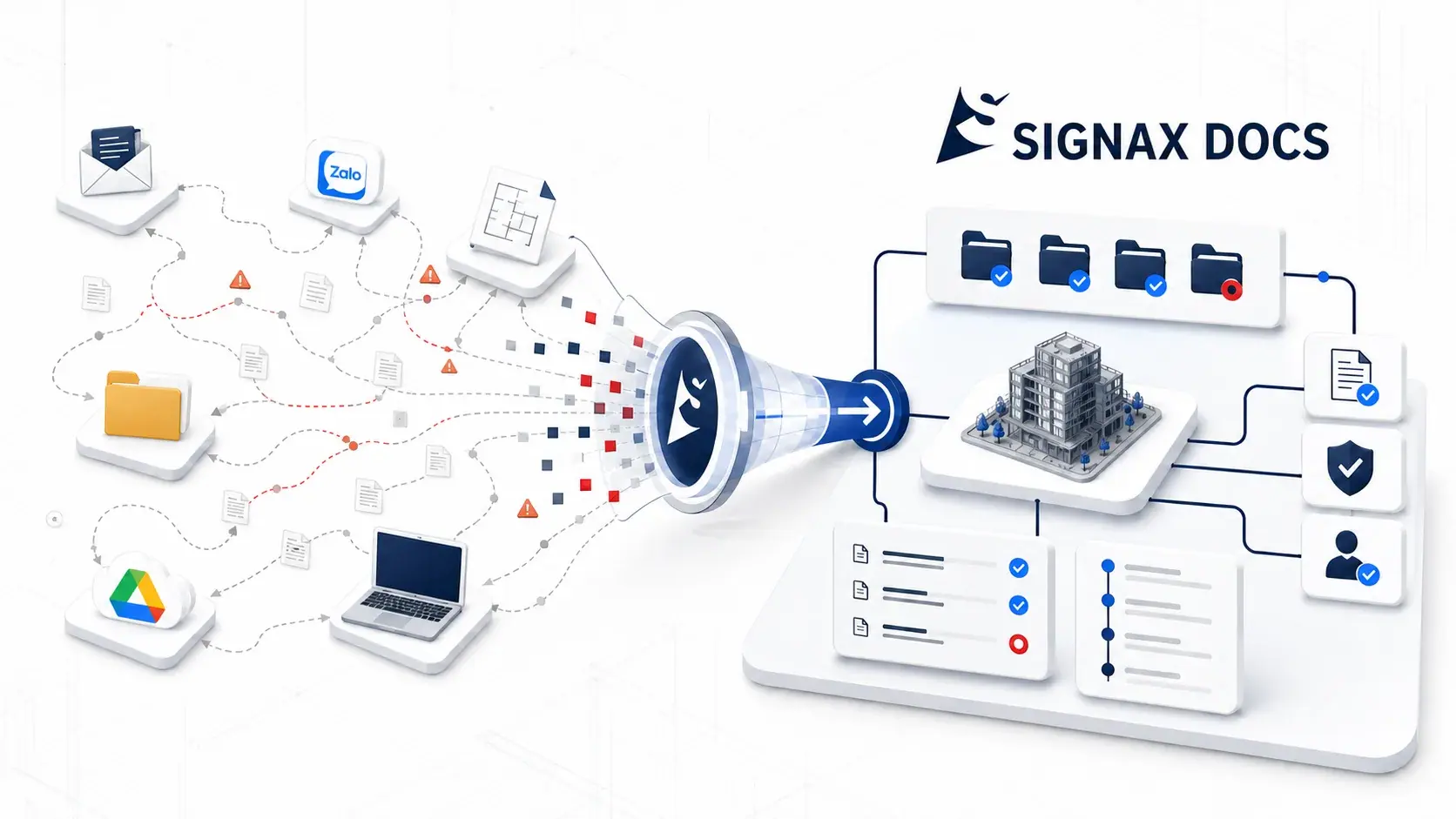
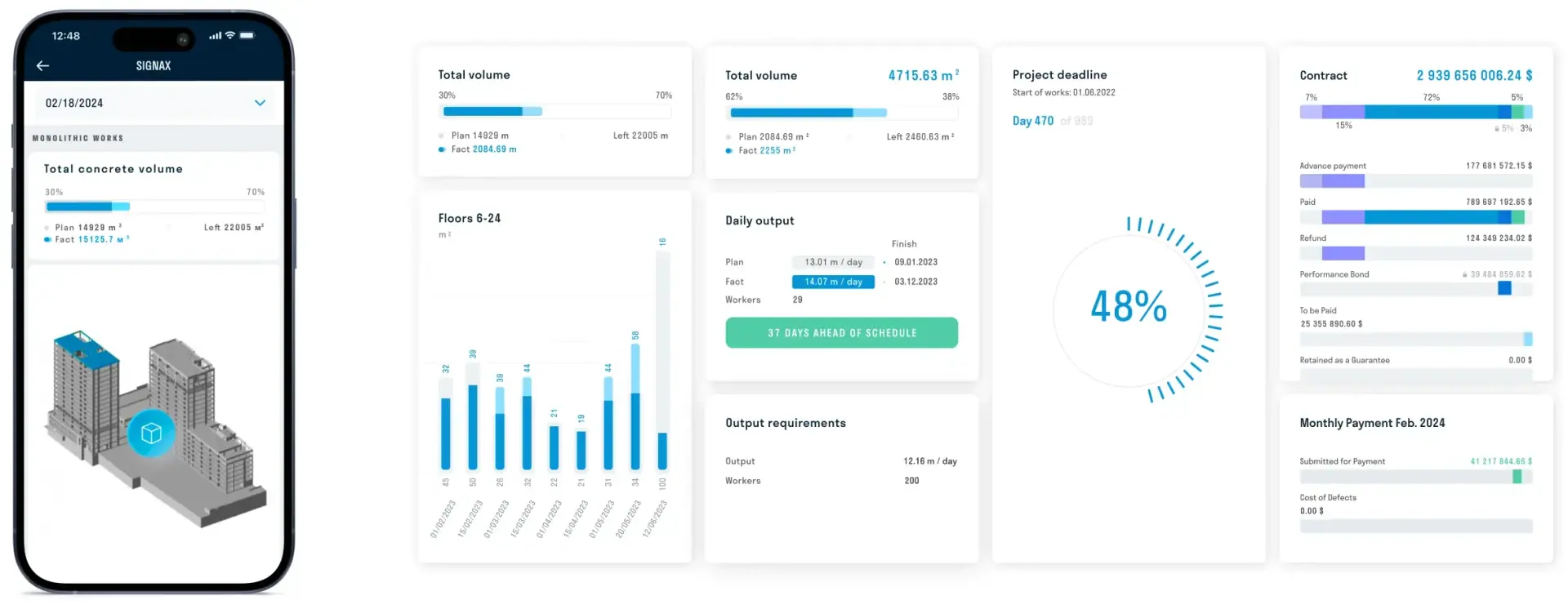
SIGNAX is more than a document repository. Its five modules address connected layers of the same construction project: DOCS controls files and approvals; FORMS structures as-built records and signatures; TOOLS connects BIM data with quantities and execution; INSPECTION brings 360° imagery, issues, and field observations into context; and DASHBOARD consolidates progress, approval status, and management indicators.
The value lies in the links between those modules. A field issue can sit in the context of a drawing or model; its resolution status can feed reporting; and the eventual decision remains traceable to the issued information. That is the difference between buying several digital tools and creating a digital workflow.
- DOCS: versions, review workflows, issued-for-construction controls, and audit history
- TOOLS: Revit, Navisworks, AutoCAD, model checking, quantities, and plan-versus-actual comparison
- INSPECTION: 360° imagery, field issues, date comparison, and BIM-linked observations
- DASHBOARD: a unified reporting layer for progress, approvals, quantities, and leadership
Advantage two: the organisation chooses where data runs
SIGNAX offers both cloud delivery and on-premise deployment on customer infrastructure. SIGNAX's official documentation says the on-premise edition can operate inside a corporate network with or without an internet connection, while giving the organisation control over its data and room for customisation.
That choice matters to large developers, industrial businesses, infrastructure projects, and organisations with strict data policies. Instead of forcing governance to fit one hosting architecture, the organisation can select an architecture suited to its security and data-ownership requirements.
Advantage three: open to the toolchain, implemented locally
SIGNAX supports PDF, DWG, BIM models, Microsoft Office, and Google Workspace, and publishes direct integrations with Revit, Navisworks, and AutoCAD alongside API-based connectivity. Teams can retain the authoring and coordination tools they already use rather than replacing an entire ecosystem merely to establish a CDE.
In Vietnam, TPG TECH provides more than software access. The implementation team configures review workflows, permissions, naming conventions, user training, and operational support for the responsibilities of developers, contractors, and consultants. That closes the frequently overlooked gap between software that has features and a system that is actually used on a live project.
Where SIGNAX differs from global and domestic options
Against global suites, SIGNAX's advantage is not a claim that every individual feature is deeper. It is the balance of construction-specific capability, deployment control, toolchain connectivity, and direct implementation support in Vietnam. An organisation can reach an appropriate operating model without necessarily carrying the full complexity of a global ecosystem.
Against domestic platforms focused on CDE or project management, SIGNAX stands out through the breadth of the DOCS–TOOLS–INSPECTION–DASHBOARD chain and the depth of its BIM-to-field connection. TPG TECH then supplies the local advantage at the configuration, training, and operational layer, rather than requiring the customer to trade product breadth for local support.
When SIGNAX is the stronger choice
SIGNAX is most compelling when the goal is not simply to digitise a project folder, but to create a controlled source of information from design through field execution and management reporting. The final decision should still be tested in a demonstration using the proposed project's own documents, roles, and approval workflow.
- The project needs CDE, BIM coordination, field inspection, and dashboards in one connected system
- The organisation needs a choice of cloud, on-premise, or a tailored data architecture
- Teams want to retain Revit, Navisworks, AutoCAD, and common construction file formats
- Success depends on Vietnamese-language process configuration, training, and ongoing support
The verdict
- SIGNAX differentiates itself by connecting documents, BIM, field inspection, and dashboards in one workflow.
- Cloud and on-premise deployment give organisations control over data architecture.
- Compatibility with common tools reduces the cost of changing the existing ecosystem.
- TPG TECH adds implementation, training, and support suited to projects in Vietnam.
Official sources reviewed
A common data environment for your projects
TPG TECH implements the SIGNAX platform in Vietnam: document control, BIM coordination, site inspection and progress reporting in one common data environment.
Explore the SIGNAX CDE platform